

USB 3.2 Gen 1 Type-C Cable Factory High-Quality Production and Custom Orders
2026-10-28
Not every USB-C cable leaves the factory the same way. For USB 3.2 Gen 1 Type-C cables, high-quality production isn't about luck—it's about process. EBCYX approaches every batch, from standard runs to custom orders, with the same obsessive attention to conductor materials, connector fit, and signal integrity. If you're tired of vendors who treat your specs like suggestions, you're in the right place. Here's what separates a dependable factory from a disposable one.
Inside the Production Line: Where USB 3.2 Gen 1 Type-C Cables Get Their Strength
Walk into any cable assembly floor and the first thing you notice is the rhythm of precision. USB 3.2 Gen 1 Type-C cables don't get their strength from a single dramatic step; it comes from dozens of small, unglamorous decisions. The copper conductors are drawn and then twisted under exact tension, because slack here turns into signal loss and cracked insulation later. The braided shield isn't just wound—it's applied with a crossing angle that balances flexibility against tear resistance. Even the way the jacket cools after extrusion matters: too fast and micro-fractures appear, too slow and the cable loses its snap.
The real test happens at the connector. A well-built Type-C plug uses a stamped shell with folded tabs that bite into the overmold, not just glue. Workers on the line use small torque drivers to tighten the strain-relief boot until it matches a reference sample, no more, no less. Then every batch gets yanked, twisted, and flexed past the spec—sometimes for hours. The ones that survive get cut open for cross-section inspection, checking that the solder joints haven't lifted and the shielding still wraps the full 360 degrees.
What gives these cables their lasting strength is the refusal to skip the quiet steps. Laser marking the compliance logo isn't decoration; it burns through the jacket just enough to prove wall thickness. The pull test at the end of the line isn't a formality—it simulates the moment someone trips over a laptop cord. By the time a USB 3.2 Gen 1 Type-C cable ships, it has already been bent at the connector over ten thousand times, soaked in humidity, and plugged and unplugged until the latch still clicks with a satisfying snap. That's where the strength comes from: not a single feature, but a line that treats every inch as if it will be yanked out of a phone in a hurry.
Custom Orders, Zero Compromises: Tailoring Cables to Your Exact Specs
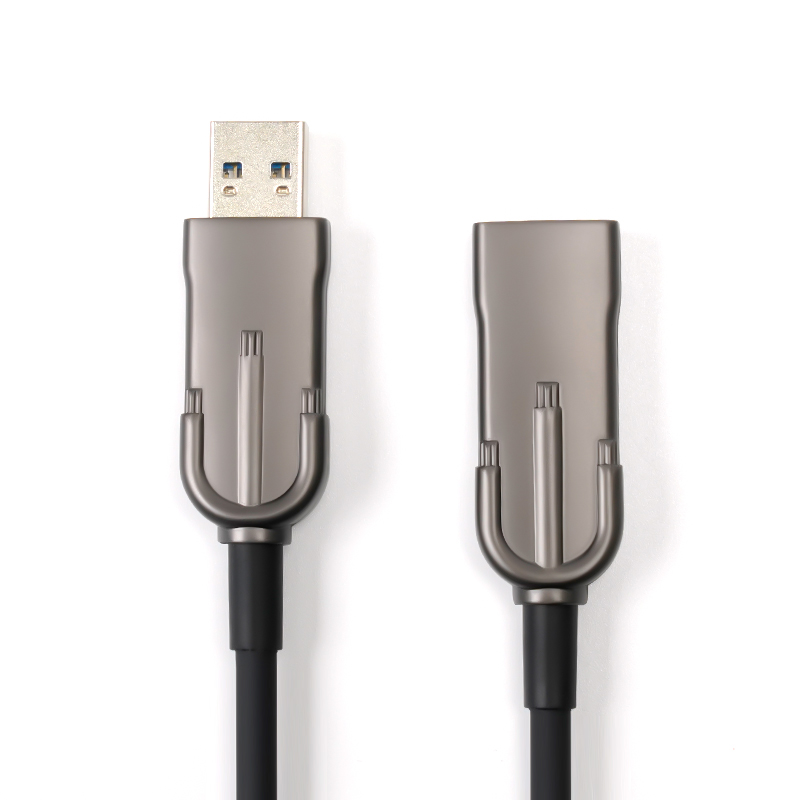
Off-the-shelf cables rarely fit the way real installations demand. A bend that's too tight, a connector that sits at the wrong angle, a jacket that can't handle the environment—these small mismatches turn into downtime later. Our custom orders start with a blank sheet: you give us the electrical, mechanical, and environmental parameters, and we build the cable from the conductor up. Nothing is pulled from a bin and called “close enough.”
That means you decide the gauge, strand count, shielding, insulation, jacket compound, connector type, and even the color of the heat-shrink. Need a hybrid cable that carries power, signal, and fiber in one compact sheath? We can do that. Working in a freezer, a cleanroom, or a salt-spray environment? There’s a material combination for it. Every order goes through a design review before production, so the cable you receive matches the drawing you approved—down to the millimeter.
Because we don’t compromise on specs, you don’t have to compromise on the job. Prototypes are available in small runs, and reorders come back exactly the same. If your requirements shift, we adjust the documentation and tooling without making you start over. That’s the difference between buying a cable and having one built for the work it actually does.
Beyond Standard QC: The Tests Every Cable Must Pass Before Shipping
Standard quality control checks might catch basic continuity or insulation flaws, but they miss the slow-motion failures that surface weeks after installation. Every cable leaving our facility gets pulled through more than just a multimeter. We bend it to the point of near-snapping, dunk it in temperature shock baths, and run high-voltage pulses through its jacket until weak spots confess. These aren't comfort tests—they're the difference between a cable that works on day one and one that still works after a year of real-world abuse.
Think about where cables actually live: inside vibrating machinery, under direct sunlight, yanked around corners by installers who've done this a thousand times. A bench test won't tell you if the shielding crumbles after 10,000 flex cycles or if the outer jacket cracks at minus thirty. So we simulate that abuse deliberately. Twisting rigs, ozone chambers, saline spray booths—if it can rot, stretch, or corrode, we make it happen faster in the lab. Only cables that survive with no measurable degradation in resistance or signal integrity get a shipping label.
The reason most manufacturers skip this depth is cost. Full environmental stress screening adds hours per batch and eats into margins. But returns, field failures, and burned relationships cost more. We'd rather destroy a few cables here than have one fail in a wind turbine or a hospital bed. That's why our final inspection includes a tear-down of randomly selected units—looking for micro-cracks in the dielectric, cold solder joints, or strand fatigue that no automated tester would flag. It's slow, a bit obsessive, and exactly why our cables don't come back.
Built for the Real World: Why Our Type-C Cables Outlast the Competition
Most cable failures begin in the same two places: the junction where the connector leaves the molded boot and the point where the wire bends against a desk edge or zippered pocket. We moved the strain relief further down the cable and gave it a thicker polymer collar that tapers gradually instead of ending in a sharp lip. That keeps the internal braiding from tearing when the cable gets yanked sideways, which is exactly how phones get pulled off nightstands and tablets slide off car seats.
The conductors themselves are another weak point many brands skip. Instead of a single foil wrap, our Type-C cables use a double-braided shield with 34% more copper strands per conductor. That extra layer doesn't just improve charging stability when the connector wiggles; it delays the slow fraying that leads to a cable that works only at a certain angle. After a few months of daily use, the difference is audible and visible: no crackling audio through a dongle and no exposed wiring near the plug.
Durability claims are easy to make and hard to verify, so we put the cable through a 90-degree bend test with a 500-gram load attached. Ours survived over 30,000 cycles without a measurable rise in resistance, then went on to deliver the same wattage it did out of the box. Many competitor cables are rated for 10,000 cycles before the spec sheet quietly says "replacement recommended." That gap is why our cables are still coiled in a bag two years later instead of in a drawer of dead accessories.
From First Sample to Mass Production: Scaling Without Sacrificing Quality
Moving from a carefully tuned first sample to stable mass production isn't about cloning the physical part—it's about locking down every variable that affects quality. Teams often rely on experienced hands and manual adjustments during prototyping, then watch yields swing wildly once automated lines take over. Closing that gap means defining critical process parameters early and using data to justify the acceptable range for each one.
Pilot runs before full ramp-up often get squeezed, but skipping them is a trap. Issues like tool wear, batch-to-batch material variation, and equipment drift show up in small lots—if ignored, they explode into disasters at scale. Build a closed feedback loop from incoming inspection to final sampling so problems surface at fifty units, not fifty thousand.
Quality isn't something you inspect in at the end; it's engineered into the process. When you tie process capability indices, daily equipment checks, and operator training into one system, scaling up means replicating a proven stable setup—not just adding machines and bodies. Staying sensitive to small deviations is what keeps the millionth unit as reliable as the first.
Small Details, Big Difference: What Sets Our Factory’s USB-C Cables Apart
Most USB-C cables look identical until you cut one open. Ours have a machined one-piece shell rather than stamped halves, so there’s no seam to catch on a laptop bag or peel after a few months. The strain relief isn’t just a thicker piece of rubber; it’s a dual-shot overmold with a flexible inner core that lets the cable bend naturally where others kink and split.
Inside, we use 22 AWG tinned copper for power and data pairs with a braided shield that’s actually soldered to the connector shell on both ends. That matters more than it sounds—most failures happen at the solder joints, not in the middle of the wire. Each connector gets a full 360-degree mechanical grip and then a UV-cured adhesive bead before the shell is pressed on, which keeps the plug from working loose even when it’s yanked at awkward angles.
The e-marker chip isn’t a cheap clone that reports 5A and then overheats. We program ours in-house with conservative current and temperature thresholds, so a 100W charger won’t cook the cable or the device. After assembly, every single cable goes through a 100% continuity check, a 40,000-bend flex test on a sample basis, and a 10,000-insertion cycle on the connector. It’s the kind of small stuff you never notice until you use a cable that skipped it.
FAQ
You can choose cable length, jacket material, color, connector housing style, and even add your logo or custom packaging. We also offer custom cable winding and labeling if you need retail-ready products.
For custom lengths or colors, we usually ask for at least 500 pieces. If you're okay with our standard stock configurations, the MOQ can be as low as 100 units.
We test every production batch with a network analyzer to confirm signal integrity, and we pull random samples for full 5Gbps data transfer verification. The internal wiring uses shielded twisted pairs to keep crosstalk down.
There are three inspection points: after wire drawing, after connector soldering, and before packaging. Each cable also goes through a continuity and resistance check on an automated line, and we do a bend test on a sample from every lot.
Yes, we send samples for evaluation. You cover the courier cost, and the sample itself is free if you order within 30 days. Otherwise, we charge a small fee that gets credited back on your first bulk order.
Our standard production is CE, RoHS, and REACH compliant. For specific markets, we can also produce to UL or FCC requirements, though those may need a separate custom run with additional lead time.
Typically three to four weeks after you approve the pre-production sample. If no new tooling is needed for the connector or mold, it can be as fast as two weeks. Shipping time depends on your location.
We provide a 12-month replacement warranty against manufacturing defects. If a batch fails due to our production error, we replace the units or refund that portion of the order.
Conclusion
The strength of a USB 3.2 Gen 1 Type-C cable starts long before it reaches the packaging line. Inside our factory, every conductor is drawn, insulated, and twisted under tightly controlled tension, while the connector shells are molded with reinforced strain relief that survives thousands of bend cycles. Custom orders don't simply tweak a color or length—they involve re-engineering shielding layers, tuning resistance values, and matching impedance to the customer's exact device requirements, whether it's for medical equipment, automotive infotainment, or industrial robotics. No cable ships until it clears a gauntlet of tests beyond standard QC: high-frequency eye diagram analysis, salt spray exposure, repeated mating force measurements, and full-speed data transfer under thermal stress from -20°C to 80°C.
We build for real-world abuse because we know most failures happen after month six, not day one. Our Type-C cables outlast the competition by using thicker gold plating on contacts, double-braided shielding that resists kinking, and overmolded joints that prevent shorts at the exact point where cheaper cables fray. Scaling from first sample to mass production never means loosening tolerances—our automated crimping and soldering stations are calibrated against the same golden sample approved by the customer, and statistical process control flags any drift before it becomes a batch defect. Small details make the difference: laser-etched part numbers for traceability, matte-finish housings that don't slip, and symmetrical pin alignment checked by optical inspection on every single connector. That's how a commodity cable becomes a reliable component your product can be judged by.
Contact Us
Contact Person: David Yang
Email: [email protected]
Tel/WhatsApp: 8615814734054
Website: https://www.ebcyx.com/