
Textured Geomembrane Factory: A Behind-the-Scenes Look at Production Quality and Performance
2026-08-14
Ever wondered what separates a reliable textured geomembrane from one that fails under pressure? Inside the factory floor, the answer isn’t just raw materials—it’s the quiet obsession with production quality and performance that many suppliers gloss over. From resin blending to surface texturing, every step shapes how well the liner grips, welds, and withstands harsh environments. At JInseed Geosynthetics Solution, that behind-the-scenes rigor is what turns a standard roll into a long-term containment asset. In this post, we step past the glossy brochures and into the real mechanics of manufacturing—what to look for, what to avoid, and how production choices directly impact field performance.
The Resin Gate: What Gets Rejected Before a Textured Geomembrane Run Starts
Before a single pellet hits the extruder throat, the resin gate acts as the last physical checkpoint. It isn't a formality. A batch can look clean from the sampling port yet still carry enough absorbed moisture to foam inside the barrel during plastication. For textured geomembrane runs, that translates directly into surface pinholes and weak spots at the texture peaks, so any lot with moisture above 0.04% by weight gets flagged and set aside.
Contamination is the obvious reject, but the subtler failures matter just as much. Off-spec melt flow index—say, drifting more than 0.2 g/10min from the target—changes how the sheet draws down after the die, making the embossed pattern smear or tear. Pellets that feel tacky to the touch, have a yellowish cast, or show a wide size distribution often point to degraded regrind or poor polymerization control. Operators learn to read these signs fast because a full hopper of bad resin can ruin an entire calendar day's production before anyone catches the problem in a lab test.
Rejected resin doesn't get a second chance at the gate. It goes back to the supplier or gets downgraded for non-critical molding work. The cost of rejection stings, but it is far cheaper than shipping a container of liner that fails a seam peel test or develops stress cracks after six months under UV. That is why the gate exists—not to slow things down, but to keep the run honest from the first meter of textured sheet to the last.
From Flat Sheet to Surface Grip: Watching the Texture Take Form
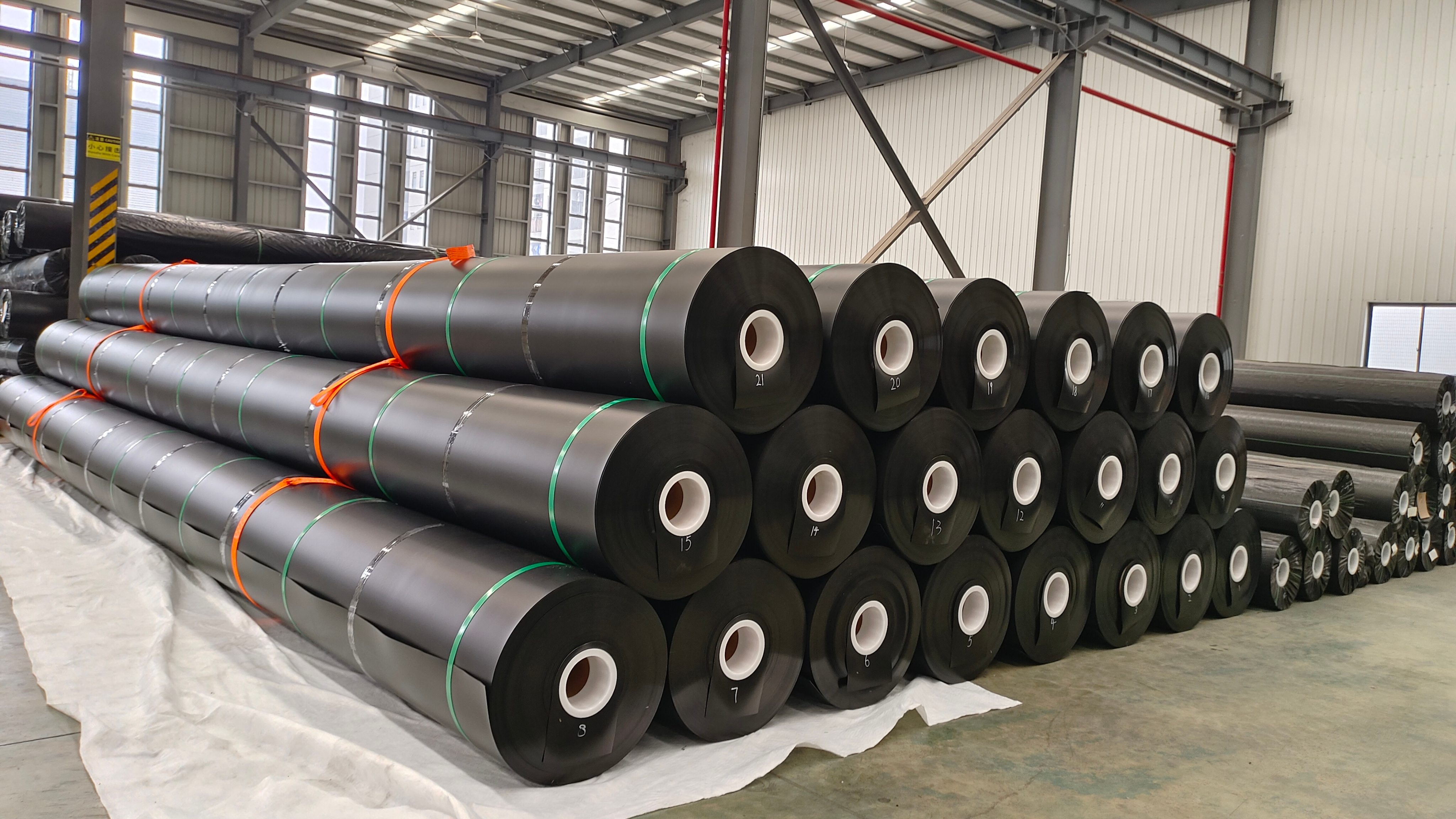
The sheet begins as a dead-flat expanse, no feature worth a finger's pause. Under the first pass of the roller, faint lines appear like scratches you'd swear weren't there a second ago. The metal doesn't buckle or tear—it just stops being a mirror and starts holding a pattern, one narrow row at a time.
Watch the press cycle a few times and you catch the build-up: a crosshatch deepens, sharpens at the edges, then gets hit again from a different angle. What looked random now locks into a grid of tiny ridges. Each pass leaves its own mark, and you can trace which direction the tooling moved by how the light breaks across the new topography.
By the final stroke, the once-slick surface offers real bite. Run a thumb across it and the resistance is immediate—not rough, but deliberate, like the material learned to hold on. The flat sheet is gone, replaced by a grip pattern that feels engineered rather than applied.
Thickness Maps and Carbon Black Checks That Keep Every Roll Honest
Thickness maps aren't just a single number; they chart the full cross-web profile. A laser micrometer or beta gauge sweeps the roll while it's still moving, logging hundreds of points per pass. Operators see high spots from uneven calendering, edge bead, or worn doctor blades. Instead of finding out after coating or laminating, adjustments happen on the line.
Carbon black checks go beyond visual color. A small core sample is burned in a TGA furnace or tested with a dispersion analyzer. The target isn't just average loading—it's uniformity of the particle network. Poor dispersion creates hard spots that tear under tension or spots with high resistivity. We compare these values against the roll map to trace any deviation to a specific mixing batch or screw zone.
The payoff is trust. A roll that passes thickness and carbon black checks can ship without a second guess from downstream. No hidden thin lane that fails in the field, no conductive dead zone that burns out in a cable. Every roll gets the same map and the same check, so what leaves the floor is what the spec says it is.
Puncture Rigs and Oven Aging: Simulating Decades of Landfill Stress
Landfill liners rarely fail from a single dramatic event. Instead, they degrade under a slow accumulation of insults—sharp stones pressing from below, equipment traffic overhead, and the relentless heat of decomposing waste. To compress forty years of service into a few weeks of testing, engineers turn to two workhorses: puncture rigs and forced-air ovens. Neither is glamorous, but together they bracket the mechanical and chemical stresses a geomembrane will face.
A puncture rig is essentially a controlled stab. A steel probe, sized and shaped to mimic a gravel particle or construction debris, is driven into a clamped liner sample at a steady rate. The machine records force versus displacement, producing a curve that reveals not just the peak puncture strength but the material's stiffness and elongation before rupture. What makes this relevant to landfill aging is the way repeated, sub-failure loads can create micro-tears. Some labs run cyclic puncture tests, loading and unloading a dull probe thousands of times to replicate the jostling of waste settlement. The result is a liner that looks intact but has lost a significant fraction of its original puncture resistance—exactly the kind of hidden damage that shows up decades later.
Oven aging tackles a different enemy: oxidation. Polymers like HDPE react slowly with oxygen, a process accelerated by heat and the acidic leachate inside a landfill. In a standard test, liner specimens are hung in an oven held at 85°C or 90°C, sometimes with air circulation, for 30, 60, or 90 days. By measuring tensile strength, elongation, and melt index before and after exposure, engineers can estimate how quickly the material is losing its molecular weight and flexibility. More sophisticated setups add a leachate bath or a pressure vessel to simulate the combined effect of heat and aggressive chemicals. The trick is picking a temperature high enough to speed up the reaction without triggering degradation mechanisms that wouldn't occur at landfill temperatures. Too hot, and the test lies to you; too cool, and you're waiting half a year for data. That balance—and the willingness to poke holes in a liner until it confesses—is what makes these two methods indispensable for predicting whether a liner will still be doing its job when the next generation starts asking questions.
Regrind Loops and Energy Logs Behind a Cleaner Production Floor
On many factory tours, the real story doesn't sit on the polished assembly line—it hides in the scrap bins and utility meters. A cleaner production floor often starts with a tightly managed regrind loop, where off-spec parts, runners, and edge trim get fed back into the material stream instead of landing in a dumpster. The trick isn't just grinding and reusing; it's tracking the ratio of virgin to regrind per machine, watching for contamination like dust or mixed polymers, and knowing when a batch of recycled material has degraded enough to affect melt flow. Operators who log regrind percentages by shift can spot a trend before it turns into a quality hold, and that keeps the floor less cluttered with rejected inventory.
Energy logs are the quieter partner in the same effort. A machine that runs hot or cycles too long might still hit its production numbers, but it's bleeding power and radiating heat into the workspace. When maintenance teams pull weekly amp draws or compressed air leak audits, they start seeing patterns: a dryer left on during lunch, a hydraulic pump that never drops to standby, or a barrel heater fighting a worn thermocouple. Fixing those small leaks and idle loads doesn't just lower the electric bill—it reduces the ambient temperature, cuts down on cooling fan noise, and makes the whole area feel less like a furnace. Some plants post a simple chart near the coffee station showing kilowatt-hours per kilogram of good product, and that single number starts conversations no manager needs to force.
What ties regrind loops and energy logs together is the habit of looking at waste as information. Every scrap part and every unnecessary kilowatt is a signal about a process drifting off center. Teams that treat those signals as part of the daily routine—sorting regrind by resin type, logging compressor run times, checking hopper loader filters—end up with fewer surprise shutdowns and less sweeping at the end of the shift. The floor doesn't get cleaner because someone bought a new scrubber; it gets cleaner because the sources of mess and heat were engineered out, one data point at a time.
The Final Roll Audit: Labeling, Core Strength, and What Ships Out
The final roll audit is less about chasing perfect numbers and more about catching what the lab can't see. Labeling gets checked under the same overhead lights the warehouse uses, not just under a desk lamp. A barcode that scans clean at arm's length but turns into a gray smear from a forklift seat gets flagged before it leaves the floor.
Core strength is measured after the roll has been handled, not fresh off the winder. If a clamp truck leaves bruises at the edges or the core shows any egging, that roll is set aside even when crush tests fall within spec. The audit sheet logs the actual clamp pressure, core ID, and rewind tension for every questionable roll.
What ships out is the short stack that survived re-handling, re-labeling, and a second look at the outer wrap. No pass/fail stamp. Just a dated note with the operator's initials and the reference roll used that shift.
FAQ
The textured pattern is formed during the extrusion process by passing the molten polyethylene sheet through a specially engraved roller or by spraying additional resin onto the hot surface. This creates a consistent asperity height that improves soil-geomembrane interaction.
The surface roughness increases interface friction, so the liner resists sliding even under heavy cover soil or waste loads. That reduces the need for external anchorage and speeds up placement.
High-density polyethylene or linear low-density polyethylene blends dominate because they balance chemical resistance, stress crack resistance, and flexibility. Some factories add carbon black for UV stabilization, which is critical for exposed applications.
Automated scanning systems measure thickness at multiple points across the web in real time. If variation exceeds a tight tolerance—often within a few percent—the line adjusts or flags the section for removal.
Samples are cut from each lot and subjected to tensile testing, tear resistance, puncture resistance, and carbon black dispersion checks. Some factories also run a multi-axial tension test to simulate field stress conditions.
Thin spots, surface pinholes, and texture inconsistency are the usual suspects. In-line cameras and pressure decay tests catch most of them, but a final visual inspection under bright light still matters for catching subtle texture defects.
Yes, many lines are designed with interchangeable rollers or modular texturing units. Switching between products usually takes less than a shift, but the factory must purge the extruder thoroughly to avoid contamination between resin grades.
Conclusion
Before a textured geomembrane run begins, every resin lot faces a hard stop at the incoming gate. If melt flow, density, or additive dispersion lands outside spec, the material gets sent back—no exceptions. Once approved resin reaches the line, flat sheet transforms under controlled heat and pressure into a durable surface grip, with texture depth and pattern consistency checked in real time rather than assumed. Thickness maps built from full-width scanning catch thin spots that would otherwise slip through, while carbon black dispersion tests confirm the UV-shielding quality that keeps a liner viable for decades under direct sun. These checks anchor the entire production run, not as paperwork, but as the first line of defense against early field failure.
Downstream, puncture rigs and long-term oven aging put finished samples through the kind of abuse a landfill cell dishes out over thirty years—slow, relentless, and unglamorous. The data from these tests feeds back into line settings, so performance is verified long before a roll leaves the floor. Behind the scenes, regrind loops and energy logs push the factory toward a cleaner footprint without weakening the product, proving that environmental care and raw durability can share the same process. The final audit then checks every label, core strength, and edge wrap against the order before shipping. A roll that leaves this dock carries more than a spec sheet—it carries the weight of every rejection, every map, and every simulated failure that never made it to the field.
Contact Us
Contact Person: Jerry Qiu
Email: [email protected]
Tel/WhatsApp: +65 84265294
Website: https://www.jinseed-geo.com