

Professional Continuous Still: Mastering the Art of Efficient Distillation
2026-06-10
Distillation isn’t just a process—it’s a craft where precision meets patience. Yet, for professionals seeking relentless throughput without sacrificing purity, batch methods often fall short. Enter the continuous still, a paradigm shift that redefines efficiency in separation technology. In this guide, we’ll explore how mastering continuous distillation can transform your operation, from foundational principles to advanced optimization. Whether you’re scaling up or fine-tuning, our insights—paired with cutting-edge solutions from DYE—will equip you to push boundaries. Ready to rethink what’s possible in your distillery?
Understanding the Continuous Distillation Process
At its core, continuous distillation is a steady-state separation technique that never really rests. Unlike batch operations where a fixed amount of feed is processed in cycles, this method constantly introduces the mixture into a column while simultaneously drawing off the purified components from different stages. The column itself is packed with trays or structured packing materials that promote intimate contact between rising vapor and descending liquid, creating a cascading series of tiny equilibrium stages. What makes it uniquely efficient is the temperature gradient that naturally develops from bottom to top, allowing lighter fractions to concentrate near the top condenser and heavier ones to collect near the reboiler.
Operating such a system requires a delicate balance of variables that can challenge even experienced engineers. The feed point location, for instance, isn't arbitrary—it's chosen based on the precise composition of the incoming stream, hitting the column where the internal mixture matches most closely. Reboiler heat input and reflux ratio then tune the separation sharpness: too little reflux and you'll see product purity slip; too much, and you're simply recycling heat without benefit. What's often overlooked is how startup procedures differ dramatically from normal operation, sometimes requiring total reflux conditions for hours before the column finds its equilibrium sweet spot.
Key Components of a Professional Continuous Still
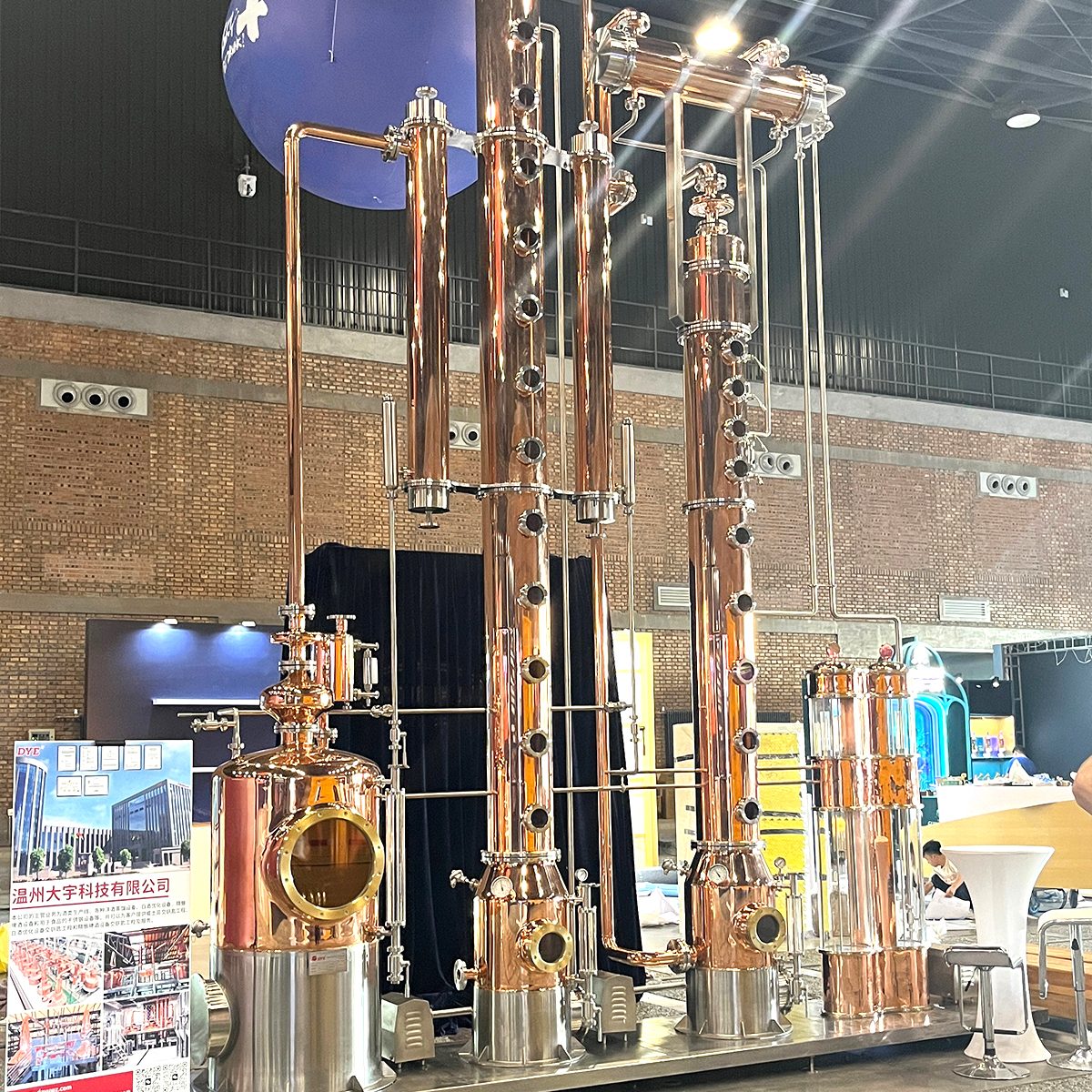
A continuous still operates on the principle of continuous feed and output, yet its heart lies in the thoughtful arrangement of several core sections. The stripping column, where the initial crude separation occurs, receives the preheated wash and begins coaxing alcohol vapors upward while spent solids and water flow downward. Just above it, the rectification column further refines these vapors through intimate contact with a descending reflux stream, stripping away heavier, less desirable fractions. This dual-column dance, often aided by a decanter to separate fusel oils, rests upon the precise control of heat, steam, and plate design — each bubble cap or sieve tray meticulously spaced to optimize the ascending vapor-liquid interaction that defines a quality spirit.
Equally critical are the ancillary components that often go unremarked. A steady peristaltic or centrifugal pump delivers wash without pulsation, maintaining the delicate hydraulic balance required for stable column operation. Strategic placement of sight glasses allows operators to monitor liquid levels and ebullition vigor, small visual clues that speak volumes about the run’s progress. Then there’s the dephlegmator, a partial condenser perched atop the rectifier, which gracefully returns just enough reflux to fine-tune the alcohol strength without choking the column. These pieces, though less celebrated, form the connective tissue that turns a collection of copper and stainless steel into a seamless, living distillation instrument.
A third layer of sophistication emerges in the thermal integration and material choices that separate a workhorse still from a masterful tool. Copper not only transfers heat efficiently but scrubs sulfides, contributing to a cleaner, fruitier spirit profile, while stainless endures the long haul and provides neutral surfaces where desired. Feedstock enters through an economizer or direct injection point, often preheated by outgoing spent wash, tightening the energy loop. At the base of every column, steam coils or a calandria apply gentle, enveloping heat rather than destructive point temperatures, preserving subtle esters essential to character. It is this orchestration of materials, heat recovery, and fraction-by-fraction vigilance that constitutes the true anatomy of a professional continuous still.
Optimizing Heat and Energy Efficiency
Fine-tuning how heat moves through a building often starts with the envelope. Upgrading insulation, sealing gaps around windows and doors, and installing reflective barriers can slash the amount of energy needed to maintain comfort. It’s not just about adding layers—placement and material choice matter. For instance, rigid foam boards in basements or attics can outperform traditional fiberglass batts when installed correctly, especially in climates with extreme temperature swings.
Heating and cooling systems themselves offer another layer of opportunity. Modern heat pumps, particularly ground-source variants, deliver far more thermal energy than the electricity they consume. Pairing these with smart thermostats that learn occupancy patterns avoids wasteful conditioning of empty spaces. Regular maintenance—like cleaning coils and checking refrigerant levels—keeps equipment running near its rated efficiency, which can quietly erode over time if neglected.
Beyond equipment, behavior tweaks and passive design can drive significant gains. Opening shades on winter mornings captures free solar warmth, while strategic landscaping with deciduous trees provides summer shade without blocking low-angle winter sun. Even small shifts, like using ceiling fans to destratify warm air or cooking with lids on pots to reduce indoor humidity, chip away at energy loads. These moves don’t require large investments but build a habit of efficiency that compounds year after year.
Mastering Feedstock Preparation and Management
Raw materials rarely arrive in a form ready for immediate conversion. The real art lies in understanding how each variable—moisture content, particle size, ash composition—plays into the final yield and equipment longevity. It’s about seeing the feedstock not as a uniform commodity, but as a dynamic input that demands constant attention. Operators who thrive in this space develop an almost intuitive sense for when a batch is too coarse or when storage conditions are silently sabotaging their downstream processes.
Getting the grind just right can make or break your throughput. Oversized chunks strain conveyors and starve reactors, while overly fine material brings dust hazards and flowability nightmares. The sweet spot is elusive, shifting with humidity, seasonal supply shifts, and the quirks of your specific mill or chipper. Smart teams build flexibility into their prep lines—adjustable screens, variable-speed feeders, and a willingness to tweak settings on the fly rather than chasing a fixed recipe from a manual.
Then there’s the storage puzzle, often dismissed as mere inventory management. Piles that sit too long start composting on their own, losing carbon and inviting microbial freeloaders. Contamination from dirt, rocks, or tramp metal isn’t just a nuisance—it’s a hidden cost that chews through cutter blades and catalytic surfaces. The best facilities treat feedstock storage as a living system, monitoring temperature gradients and moisture migration, rotating stock before degradation sets in, and designing layouts that minimize handling steps. Mastery means never having to shut down unexpectedly because your raw material turned against you.
Troubleshooting Common Operational Challenges
When things start going sideways, the root cause is rarely just a single broken part. More often, you're looking at a chain of small missteps—teams working from outdated playbooks, alerts that fire too late, or a process that made sense on paper but crumbles under real-world pressure. Instead of chasing symptoms, pull together a quick cross-functional huddle. Map out the last 24 hours of the affected workflow on a whiteboard, marking every handoff and decision point. You'll usually spot the disconnect within ten minutes, whether it's a silent failure in automation or a manual override nobody documented.
Logs and dashboards can drown you in noise if you haven't tuned them to the rhythms of your own systems. Skip the generic thresholds and watch for patterns that deviate from your baseline—like a normally quiet service suddenly polling every three seconds, or a batch job that finishes ten minutes later than its weekly average. When you do catch something, avoid the urge to immediately roll back or push a hotfix without understanding the trigger. Instead, pair up a developer with someone from ops to trace the event end-to-end, comparing expected behavior against actual system calls. That pairing cuts resolution time in half far more reliably than any runbook.
After the dust settles, most teams jump straight to "how do we prevent this exact issue" and write a narrow rule that falls apart next month. A better bet is to hold a short blameless review focused on what surprised you—maybe the QA environment doesn't reflect production traffic, or your health checks aren't actually verifying user-facing endpoints. Capture those insights in a living document that anyone can update, and schedule a monthly check to see if the gaps you closed are staying shut. The goal isn't a perfect system; it's building the instinct to spot fractures before they spread.
Scaling Up: From Batch to Continuous Production
Moving from batch to continuous production isn’t just a simple switch—it’s a complete rethinking of how workflows, equipment, and quality control operate. In batch processing, each step is discrete, with materials waiting between stages, which can lead to inventory pileups and inconsistent cycle times. But when you scale up to continuous production, you need to design a seamless flow where raw inputs transform steadily into finished outputs, often requiring real-time monitoring and automated adjustments to keep everything running smoothly. The challenge lies in harmonizing reaction kinetics, heat transfer, and material handling so that the entire line operates as a single, cohesive system rather than a series of isolated batches.
One of the trickiest parts of this transition is managing the early-stage decision points that determine whether a process can even be made continuous. Engineers have to look beyond theoretical yields and consider practical factors like fouling, catalyst deactivation, and downstream purification bottlenecks. Sometimes a hybrid approach works best, where certain high-risk steps remain batch-based while the rest of the line runs continuously. It’s not always about full automation from day one; gradually phasing in automation and feedback loops can reveal unforeseen interactions without putting the entire operation at risk. This incremental rollout often uncovers latent issues with sensor placement or materials compatibility that weren’t apparent during pilot trials.
Another factor that gets overlooked is the human element. Operators who are used to batch routines need to shift their mindset toward proactive supervision of an interconnected system. Instead of logging discrete batch records, they’re now interpreting trends and responding to subtle drifts that could cascade downstream. Training programs that pair seasoned staff with data-driven dashboards can bridge this gap, turning what feels like a loss of control into a collaborative troubleshooting culture. In the end, the payoff isn’t just higher throughput—it’s the ability to rapidly adjust product specs without shutting down, and that kind of agility often becomes a hidden competitive advantage as market demands shift.
FAQ
A professional continuous still is a setup that runs without stopping, constantly feeding in wash and drawing off spirit. Unlike a pot still, which works in batches and needs to be emptied and refilled, a continuous column processes material in a steady flow. This changes everything — flavor, efficiency, and even the role of the distiller. You’re not just tweaking cuts between heads, hearts, and tails; you’re balancing an entire system of pressure, temperature, and feed rates to maintain a consistent output.
Efficiency isn’t just about saving fuel or time, though those matter. It’s about control. When you really understand how a continuous still operates, you can push it to yield exactly what you want while minimizing waste. In a commercial setting, that translates to predictable spirit profiles, lower production costs, and the ability to scale without losing quality. It’s the difference between just making alcohol and crafting a reliable, premium product day after day.
At its heart, it’s a game of heat and mass transfer. Wash enters near the top and flows down through a series of plates or packing, while steam rises from the bottom. Volatile compounds like ethanol get carried upward, and the less volatile water and solids keep traveling downward. Each plate acts like a tiny equilibrium stage where vapor and liquid mix, separate, and remix, progressively enriching the alcohol. The art lies in managing those conditions so the column finds a steady state that pulls out exactly the fraction you’re after.
Grain-based spirits shine here. Light rum, vodka, certain whiskies, and neutral cane spirits all benefit from the cleaner, more precise separation a continuous column provides. You can strip away congeners to get a blank canvas for blending or barrel aging. Heavier, more flavorful spirits like pot-still rum or single malt scotch often prefer the batch method because they rely on those robust, complex notes. But even then, many distilleries use a hybrid approach, running a column for the base and a pot for the character.
It eliminates downtime. There’s no filling, heating from cold, cooling down, or cleaning between batches. The process runs 24/7 if you want, so throughput skyrockets. Heat integration is also superior — you can recycle energy within the column, preheating incoming wash with outgoing hot water. Plus, because the system reaches a stable equilibrium, you’re not throwing away as much product on cuts. Everything is tuned to extract the maximum spirit from the wash with a consistent purity.
Stability is the biggest beast. If your feed rate wavers or the steam pressure drifts, the whole column can lose its balance, and you’ll pump out off-spec spirit until it recovers. There’s also the learning curve — you can’t just taste and adjust like with a pot still; you’re reading instruments and making micro-corrections. Build-up of fusel oils or solids on plates can mess with separation over time, too, so a rigid cleaning schedule is non-negotiable. And honestly, it can feel a bit sterile compared to the craft of running a batch, which takes some getting used to.
Conclusion
Mastering a professional continuous still goes beyond simply running a column—it demands a deep grasp of how every stage of the process interlocks. Unlike batch distillation, continuous operation relies on a steady feed and precise equilibrium, where the rectification and stripping sections work in tandem. The heart of the system lies in its components: the reboiler, condenser, column internals like trays or packing, and the control mechanisms that regulate temperature, pressure, and flow. Achieving true efficiency means optimizing heat integration, perhaps by preheating the feedstock with waste process streams or using variable frequency drives on pumps and compressors. Without this holistic view, even a well-built still will underperform.
Equally critical is the preparation and management of the feedstock. Inconsistent composition, entrained solids, or improper preheating can destabilize the column profile, leading to off-spec product or even hydraulic flooding. Seasoned operators know that troubleshooting is an art in itself—spotting early signs like pressure fluctuations or unexpected temperature shifts can prevent costly downtime. When moving from batch to continuous production, the challenges multiply: control loops must be retuned, feed systems redesigned, and operators trained to think in terms of steady-state dynamics rather than timed cycles. Ultimately, mastering efficient distillation is a blend of engineering insight, practical experience, and a relentless focus on the subtle interplay between energy, material, and control.
Contact Us
Contact Person: Ada Xu
Email: [email protected]
Tel/WhatsApp: 0577-86806088
Website: https://www.dayuwz.com/