Logo Projector Light Manufacturer for Custom Branding and Nighttime Visibility
2026-10-26
Most brands go dark the moment the sun sets—yet nighttime is when storefronts and venues draw their highest foot traffic. A custom logo projector light changes that, turning any surface into a crisp, glowing brand statement. That’s where TNT comes in: a manufacturer focused on durable, high-visibility projection that keeps your logo working after hours. Here’s what to know before you choose your next branding tool.
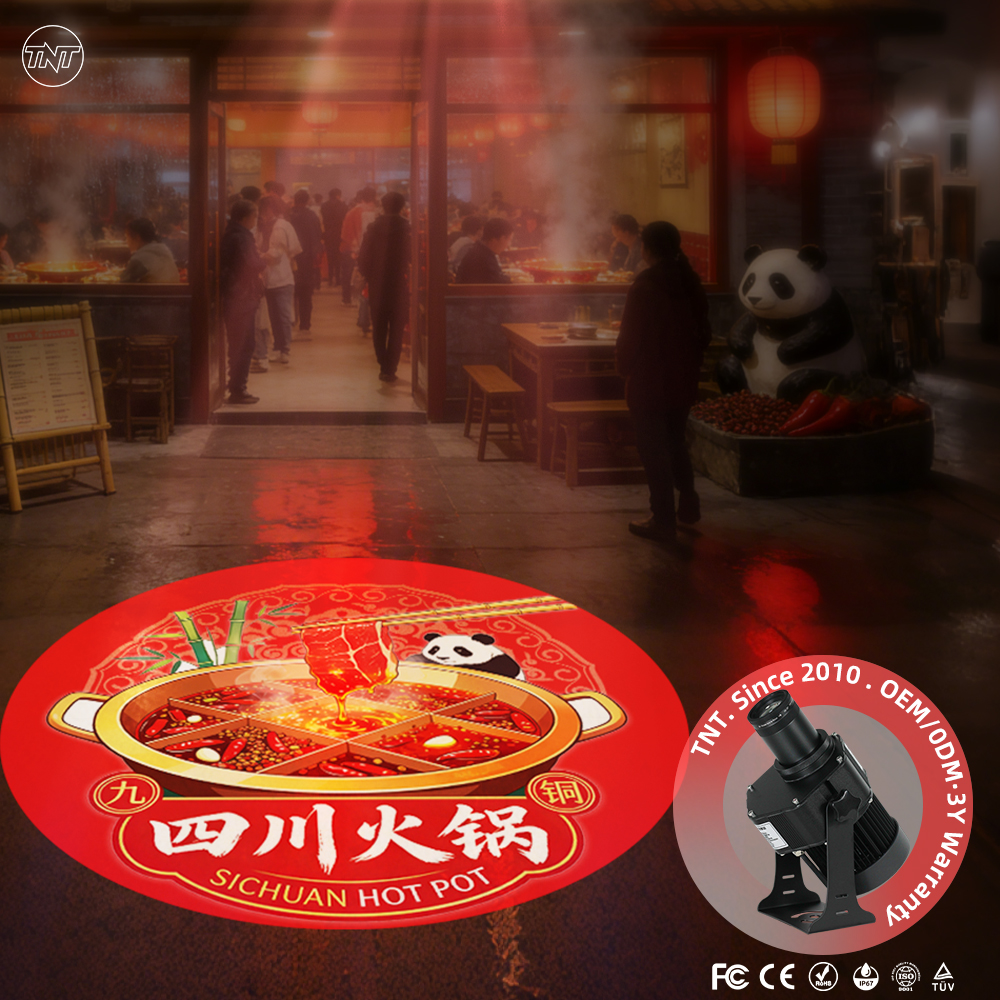
How Custom Logo Projectors Turn Empty Sidewalks Into Brand Touchpoints
A blank stretch of pavement outside a storefront rarely gets a second glance. But when a logo projector throws a crisp, moving or static brand mark across the concrete, that same sidewalk becomes an unmissable invitation. The projector works with the existing foot traffic, turning passersby into viewers long before they reach the door. It's not just light — it's a wayfinding cue that says something is happening here, even after the signs in the window have gone dim.
These units are small enough to mount on a wall, overhang, or even a nearby pole, yet the projection can stretch several feet across the ground. The result is a low-key but persistent presence that shifts with ambient light, looking sharpest at dusk and after dark. Because the image can be swapped with a simple gobo change, the sidewalk becomes a flexible space for seasonal campaigns, limited-time menus, or event-specific branding without the cost of repainting or repaving.
What makes the empty sidewalk so effective as a brand touchpoint is that it doesn't compete with a screen. People look down while walking, especially when something bright interrupts the usual gray. A well-placed projection catches the eye at the moment of decision — do I walk in or keep going? It turns an overlooked patch of concrete into a quiet argument for stopping by, and it does so without adding noise or clutter to the street.
Nighttime Visibility Without the Usual Glare and Light Pollution
Nighttime visibility doesn't have to come at the cost of glaring fixtures or washed-out skies. By directing light only where it's needed and keeping intensity modest, roads, paths, and outdoor spaces can stay easy to navigate after dark without creating harsh pools of brightness. Shielded luminaires, for instance, push illumination downward instead of letting it scatter into drivers' eyes or up into the atmosphere, which makes subtle differences in terrain and signage easier to read.
Warmer color temperatures also play a surprising role. They reduce the blue-heavy wavelengths that scatter most in the atmosphere and disrupt circadian rhythms, while still preserving enough contrast for safe movement. Rather than flooding an area with uniform white light, a mix of low-level path markers and selectively lit landmarks can guide the eye naturally, keeping the surrounding darkness intact and the stars visible.
The Manufacturing Choices Behind a Projector That Lasts Past One Season
Most projectors that die after a single season share the same weak points: dust ingestion, heat soak, and cheap optical alignment. To get past that first year, the housing is designed with a positive-pressure airflow path that pushes air through a fine mesh filter before it ever touches the DLP chip or LCD block. That filter is not an afterthought—it is sized to catch particles down to a few microns while still letting the lamp or laser module breathe, so the light engine stays clean long after the vents are clogged on lesser units.
The second choice is thermal headroom. Instead of running the LED or laser diode at its maximum rated current, the driver board is tuned to stay 15–20 percent below the datasheet ceiling. That lowers lumen output slightly on paper, but it keeps junction temperatures stable enough that color shift and brightness decay remain flat through months of heavy use. The chassis also uses a cast aluminum light tunnel rather than folded sheet metal, which pulls heat away from the prism and keeps the focus mechanism from drifting. Those are the kinds of manufacturing calls you never see in a spec sheet, but they are exactly why a unit can survive festival season, classroom dust, and a few accidental knocks without losing its picture.
Matching Projection Distance and Brightness to Real Storefront Conditions
Storefront projection rarely behaves the way a spec sheet suggests. A window that faces east gets hammered by morning sun, while the same glass at night reflects every streetlamp and passing headlight. Projection distance is usually dictated by a narrow ceiling soffit, a support beam, or the depth of the display window itself. Before choosing a projector, measure the exact throw distance from the mounting point to the glass, then match it against the lens’ throw ratio. If the projector must sit only three feet from the window but needs to cover a six-foot-wide image, a standard long-throw unit won’t work without severe keystone or spill.
Brightness needs to be judged against real ambient light, not a dark room. A single sunny afternoon can easily deliver 4,000 to 6,000 lux onto storefront glass, which overwhelms projectors rated with modest ANSI lumens. The practical fix is to raise the projector’s light output well above the ambient level and also treat the window surface itself. A high-contrast rear-projection film can reject some off-axis glare, letting a 5,000-lumen projector read clearly where a bare 8,000-lumen unit washes out. The goal is not maximum brightness but enough separation between the projected image and whatever the street is doing behind it.
Final settings come from standing on the sidewalk, not from a menu. Run the projector at the same time of day the store gets the most foot traffic, then walk back and forth while adjusting brightness and focus. If hotspots appear near the projection lens or the image dims at the edges, try repositioning the unit or reducing output slightly. At night, lower the brightness to avoid turning the window into a blinding panel that repels shoppers. Matching real storefront conditions means accepting that the best setup on Tuesday at noon may need a quick tap on the remote by Friday at six.
Why Modular Gobos and Serviceable Parts Matter More Than Spec Sheets
A spec sheet can tell you how bright a fixture is or how sharply it renders a pattern, but it won't show you what happens six months into a heavy tour schedule. When a gobo holder jams or a lens gets scratched, a modular design means you swap out a single carrier instead of shipping the whole unit back. That's the difference between a ten-minute fix in a cramped booth and a week of downtime waiting on an RMA.
Serviceable parts also change the math on long-term ownership. Threaded inserts, replaceable cooling fans, and gobo cartridges that click into place without tools all sound unglamorous—until you're the one kneeling behind a truss tower with a multi-tool and a deadline. Spec sheets often lead with lumen counts and zoom ranges, but those numbers assume everything is aligned and clean. In practice, the fixtures that stay in service are the ones you can actually take apart and put back together without a service center.
Modular gobos matter for creative flexibility too. Rather than committing to a fixed set of stamped steel patterns, you can rotate custom glass gobos or swap in a different size carrier for a one-off event. That kind of adaptability rarely shows up on a comparison chart, yet it's what lets a small rental house say yes to strange requests instead of apologizing for the gear's limitations.
Ordering a Custom Projector Without the Typical Back-and-Forth Delays
Most custom projector orders drag on for weeks because every change—lens throw, brightness spec, input configuration—triggers another round of emails or phone tag. We eliminated that by building a single intake form that captures the exact parameters your venue, screen size, and ambient light actually require. Once you submit it, a dedicated lead engineer reviews the specs and flags only genuine conflicts, not stylistic preferences. That means the first quote you receive already reflects a buildable unit, not a rough guess.
Instead of waiting for a sales rep to translate your needs into internal jargon, you get direct access to a shared workspace where the bill of materials, optical path drawings, and thermal simulations update in real time. If something needs to shift—say, the throw ratio after a last-minute seating change—you annotate the drawing yourself, and the production team sees it instantly. There’s no ticket queue, no “let me check with engineering,” no forty-eight-hour silence while someone forwards a PDF.
The result is that a truly custom projector—one with a non-standard lens mount, custom firmware for a museum installation, or a color gamut matched to a specific art piece—takes days to confirm instead of months. Delays become the exception, not the rule, because the process assumes you know your space better than we do and gives you the tools to express that directly.
FAQ
We see a lot of retail stores, hotels, restaurants, and car dealerships. Event planners also use them for temporary branding on dance floors or entryways. The common thread is they want a visible mark after dark without cluttering the space with more signs.
You can use your own logo. We build each projector around your artwork, whether it's a simple wordmark or a detailed emblem. Send us a vector file or a high-resolution image, and we’ll clean it up and show you a digital proof before we machine the gobo.
They’re made for nighttime visibility, but they still hold up under moderate ambient light. For bright, fully lit spaces, you may need a higher-lumen model. We can suggest the right output based on where you plan to mount the unit and the surface you’re projecting onto.
Vector files are ideal—AI, EPS, PDF, or SVG. If you only have a PNG or JPG, send the largest version you have, and we’ll work with it. Low-resolution images may need to be redrawn, which can add a small fee and a day or two to the timeline.
Many of our models have an IP65 or IP66 rating and are fine outdoors year-round. They’re sealed against moisture and can handle temperature swings. If you’re in a coastal area with salt air, mention that when you ask for a quote so we can recommend the right coating.
The LED modules are rated for about 30,000 to 50,000 hours, which works out to several years of nightly use. When the light does dim, the module can be swapped out without replacing the whole housing. The gobo itself doesn’t wear out under normal conditions.
You start by sending your logo and telling us the mounting distance and surface. We’ll send a digital proof and a quote. After approval, we machine the gobo, assemble the unit, and test it before shipping. Lead time is usually 7 to 12 business days, depending on the quantity and any custom housing changes.
Yes. The housing and LED can stay in place; you only need a new gobo with the updated logo. We keep your artwork on file if you want to reorder, and swapping the gobo takes just a few minutes with a small tool.
Conclusion
Sidewalk space outside a storefront rarely earns a second look, but a well-aimed gobo projector changes that. Instead of blank pavement, passersby see a crisp logo or wordmark pooled in light, turning a few square feet of concrete into a quiet brand reminder. The best units do this without adding glare that bounces into pedestrians' eyes or spilling light upward where it serves nobody. That restraint comes from lens design, beam shaping, and careful placement, not just raw lumen output. A manufacturer that understands storefront conditions will ask about mounting height, throw distance, ambient streetlight, and surface finish before recommending optics. Those details decide whether the projection reads cleanly from the curb or washes out by 9 p.m.
Durability is equally practical. A projector that survives one rainy season is not an accident; it comes from sealed housings, thermal management that handles overnight use, and drivers rated beyond the fixture's nominal load. But spec sheets only tell part of the story. What keeps a logo projector in service year after year is whether the gobo can be swapped in minutes when a rebrand happens, whether the LED module unscrews without sending the unit back, and whether replacement parts are actually stocked. The same applies to ordering. A focused manufacturer removes the usual back-and-forth by collecting artwork format, mounting surface, desired image size, and ambient light level up front, then sending a layout proof and photometric simulation instead of a vague quote. That turns what is often a six-week email chain into a two-day confirmation.
Contact Us
Contact Person: TNT SALE
Email: [email protected]
Tel/WhatsApp: 8613544277910
Website: https://www.tntprojector.com/