

Chinese Spiral Freezer: Advanced Flash Freezing Solutions for Seafood and Meat Processing
2026-11-16
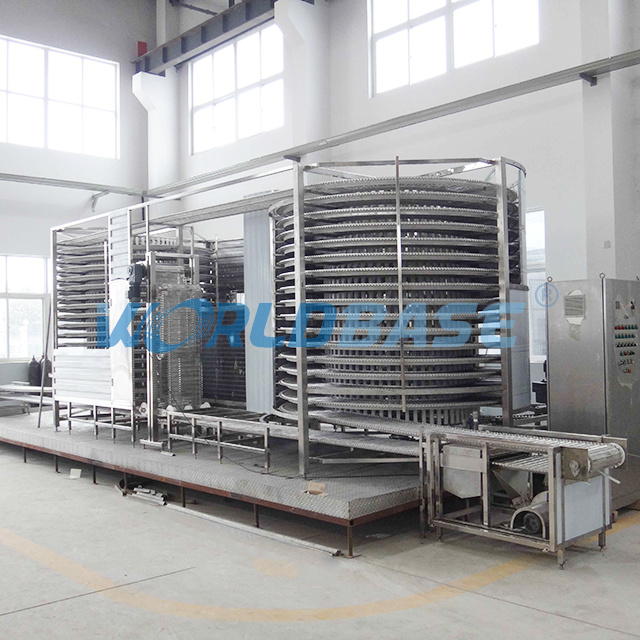
Freezing seafood or meat isn’t just about dropping temperature—it’s about racing ice crystal formation before cell walls rupture. That’s the battle a spiral freezer wins every time, and it’s why processors are taking a hard look at advanced Chinese-built systems. Worldbase has been at the center of that shift, engineering flash freezing lines that hold texture, reduce drip loss, and keep throughput high. What separates a good spiral freezer from a great one—and what should you look for before making the switch?
Why Rapid Airflow Matters More Than Temperature Alone in Spiral Freezing
In spiral freezers, setting the thermostat lower doesn’t automatically speed up the freeze. What actually pulls heat away from a product is the thin layer of air clinging to its surface. Faster airflow scrubs this boundary layer away, replacing it with colder, drier air and dramatically improving convective heat transfer. Even a modest increase in air velocity can outperform a much deeper temperature drop because the limiting factor is rarely refrigerant capacity—it's how quickly that cold can reach the core.
High-velocity air also changes how moisture behaves during freezing. Slow-moving air allows surface ice to sublimate unevenly, leading to freezer burn and weight loss. A well-directed, rapid airstream locks the surface quickly and drives heat out from all sides, especially in dense product stacks on a spiral belt. This results in smaller, more uniform ice crystals and better texture retention, which temperature alone cannot guarantee.
Finally, rapid airflow smooths out the uneven conditions that plague spiral systems. Without enough air movement, colder zones form near the evaporator coils while the center of the belt stays warmer. Boosting fan performance and tuning airflow patterns ensures each tray or package sees consistent freezing conditions, reducing core temperature variability and letting operators run shorter dwell times without sacrificing yield.
Keeping Shrimp and Scallops Separate: Airflow Patterns That Prevent Clumping
Clumping usually starts long before the product reaches its final temperature. In the first few minutes of contact freezing, residual surface water on shrimp and scallops can form ice bridges wherever two pieces touch. The most reliable way to interrupt that process is to force air through the product zone in short, high-velocity bursts rather than a steady low-speed wash. This pulsing action lifts the edges of individual pieces just enough to break thin ice films before they harden, then lets the pieces settle in a slightly different position.
Direction matters as much as speed. If the airflow only moves horizontally across a conveyor, the prawns and scallops on the bottom layer stay shielded by those above them. A workable setup alternates upward and downward angled nozzles so the air stream reaches the underside of overlapping pieces and rolls them apart. It also helps to narrow the air channels near the sides of the belt; this raises local velocity without increasing fan power and keeps edges from freezing against the mesh while the center is still loading.
One pattern that often gets overlooked is the rest period between airflow cycles. Continuous high-velocity air can actually blow light scallops against the back wall of the freezer, creating a different kind of clump. Short active pulses followed by a few seconds of near-still air let surface moisture migrate and refreeze in a thin, isolated layer. That rhythm tends to produce a more consistent IQF result than simply pushing more cubic feet per minute through the tunnel.
What a Chinese-Built Spiral Freezer Changes for Mid-Sized Meat Plants
For years, mid-sized meat processors had to choose between cramped batch freezing and expensive tunnel systems built for much larger operations. A Chinese-built spiral freezer alters that math entirely. The footprint is compact enough to fit in a modest plant, yet the belt length allows product to stay inside long enough to reach core temperatures without a huge cold storage buffer. That means a plant running two shifts can now freeze the same volume overnight instead of waiting for multiple blast chiller cycles.
The more interesting shift is in maintenance and spare parts. Older European or North American spiral units often came with lead times that could stall a plant for weeks when a bearing or drive sprocket failed. With the Chinese-built units now available, many suppliers keep motors, belting sections, and control boards in regional warehouses. For a mid-sized plant without a full-time engineering team, that is the difference between a one-day repair and a week of downtime. The electricals are also simplified; technicians who are used to PLC-based packaging lines can usually diagnose issues without specialized training.
There’s also a flexibility angle that gets overlooked. Because the spiral design stacks the conveyor vertically, a plant can add freezing capacity without adding floor space or knocking down walls. Some units can be reconfigured with additional tiers or a variable-speed drive to handle seasonal peaks—turkey or holiday ham lines, for example—without committing to a larger permanent system. For a mid-sized plant, that means capacity can follow demand instead of forcing the sales team to sell around a freezer’s limits.
Sanitary Welds, Sloped Floors, and Other Details Seafood Inspectors Notice
The first thing a seafood inspector does after the walkthrough is run a finger along the welds on processing tables and conveyors. If the weld feels anything but glass-smooth, it gets flagged. Pinholes, undercut, or sugaring on stainless steel create micro-tears where protein and moisture collect. Even a well-passivated surface can hide contamination in a rough weld. Operators often polish the visible faces and forget the underside of a seam, but inspectors check there too.
Floor slope is checked less by measurement and more by watching water behave. After a rinse-down, inspectors look for any puddle that lingers more than a few seconds. The transition from floor to trench drain is the usual failure point: concrete that levels out too soon, a drain grate set proud of the floor, or a crack running parallel to the slope. These spots stay damp long after the rest of the floor has dried, and standing water in a seafood plant is never just water.
Other details get equal attention: the inside radius of coving where wall meets floor, the space under a scale base, a gasket that has started to pit. Inspectors may use a flashlight to check beneath equipment or a mirror to see behind pipes. Anything that traps solids or resists a direct spray from a hose is a potential finding. The common thread is that these are all places where cleaning crews have to work around an awkward angle, and inspectors know exactly where those angles are.
Balancing Throughput and Dehydration Loss on High-Moisture Product Lines
On high-moisture product lines, pushing line speed beyond the dryer’s rated capacity often shows up first as uneven moisture pockets—some batches leave too wet, others overdried and brittle. The real balancing act isn’t simply slowing down or speeding up; it’s mapping the relationship between residence time, air velocity, and surface evaporation. Operators who adjust inlet air temperature by just a few degrees can sometimes recover 2–3% dehydration loss without sacrificing throughput, especially when the product enters with variable moisture from upstream washing or blanching.
A practical approach is to treat dehydration loss as a quality signal rather than an unavoidable cost. For example, if a pet food or vegetable line sees shrinkage above 4% while hitting target throughput, that often points to overdrying at the belt edges or uneven airflow. Installing adjustable air baffles or rebalancing zones lets you maintain a higher line speed by targeting the wet spots instead of applying uniform heat. In many cases, the fastest lines aren’t running maximal temperature—they’re running data-driven zone control that protects yield while keeping the conveyor full.
Ultimately, balancing throughput and dehydration loss means accepting that the two metrics share a nonlinear curve. Beyond a certain speed, losses climb sharply while output gains flatten. Teams find their sweet spot by tracking weight loss per unit of throughput over short intervals, then locking in settings that keep dehydration within spec. Small changes—like pre-drying surface water with an air knife or adjusting belt loading density—can shift that curve rightward, delivering both more product and less shrinkage than standard operating parameters suggest.
Custom Tier Spacing and Belt Width for Marinated, Bone-In, and Coated Products
Processing lines that handle marinated, bone-in, or coated foods rarely perform well with off-the-shelf conveyor spacing. Bone-in cuts, for instance, can snag or wedge between tiers if the vertical gap doesn't account for irregular protrusions. A custom tier spacing calculation starts with the maximum product height after bone protrusion and then adds a safety margin that still preserves throughput density. For marinated items, the extra few millimeters prevent sauce pooling and uneven air flow, while coated products need enough clearance to keep breading intact through turns and transfers.
Belt width follows a different logic. It should mirror the expected product orientation and the downstream equipment's infeed width, not just the nominal line speed. If bone-in thighs are loaded diagonally, a belt that's too narrow forces operators to straighten them manually, slowing the line. Wider belts with gentle side guides allow slight rotation without jamming, but excessive width wastes energy and makes sanitation harder. The right width pairs with tier spacing so that product never touches the sidewalls at the critical points where coating or marinade is still wet.
One practical approach is to mock up the worst-case product profile—a double-lobed bone-in breast with heavy marinade and a thick coat—and run it through a short prototype section. Adjust tier spacing until the product passes without scraping, then reduce by 5 mm to reclaim vertical space. For belt width, load three products in the most awkward orientation and watch for edge contact. These small customizations rarely add significant cost when specified before fabrication, but they eliminate most jams, coating loss, and rework on the floor.
FAQ
It combines a tightly controlled airflow pattern with a compact spiral belt, so surface ice crystals form quickly without damaging delicate shrimp or dense beef cuts. The adjustable dwell time lets operators fine-tune results for scallops, fish fillets, chicken portions, or marinated pork.
The vertical stacking of the conveyor means the product travels a long freezing path while occupying a relatively small footprint. A unit that handles several tons per hour can often fit into the same area as a standard loading dock, which is a major advantage for mid-size processors.
Yes. The belt speed, air temperature, and airflow direction can be adjusted separately. For sticky marinated meats or IQF shrimp, we often recommend a slightly higher initial blast to set the surface, then a gentler second stage so pieces do not clump.
Most models operate from -35°C to -40°C air temperature, with belt widths from 600 mm to 1200 mm and capacities from 300 kg/h up to several tonnes per hour depending on product thickness and required freezing time.
Yes, the structure is usually stainless steel with sloped surfaces, minimal horizontal ledges, and removable belt guides. Many units are designed for daily low-pressure rinsing and weekly deep cleaning without trapping water or debris.
It often uses variable-speed fans and a demand-based defrost cycle rather than fixed timed defrosting. The evaporator coils are arranged to reduce frost buildup, so the system spends less energy fighting ice and more energy actually freezing product.
Buyers usually receive installation supervision, operator training, and remote diagnostics. Spare parts like belt links, fans, and sensors are kept in regional warehouses to minimize downtime for seafood and meat processors.
Conclusion
The real advantage of a Chinese spiral freezer lies in how it manages air, not simply how cold it gets. Fast, directed airflow strips heat from product surfaces before ice crystals can grow large, which is why shrimp and scallops stay separate instead of freezing into a block. By tuning air patterns to each product line, the system keeps individual pieces from clumping while still moving high-moisture loads through the spiral at steady rates. For mid-sized meat plants, this means the same freezer can handle marinated cuts, bone-in portions, or coated items with only a change in tier spacing and belt width, so one line does the work of several.
Details that seafood inspectors look for are built in from the start: sanitary welds, sloped floors that drain completely, and belt materials that can withstand aggressive washdowns. These features reduce hidden contamination risks and cut downtime between product changeovers. At the same time, balancing throughput against dehydration loss matters because too much airflow can pull moisture out of high-value proteins, shrinking yield. A well-designed spiral freezer adjusts air speed and dwell time to keep weight loss low while still hitting target core temperatures. For processors, that combination of inspection-ready construction and flexible airflow control is what turns a standard freezing tunnel into a real production asset.
Contact Us
Contact Person: Mr Yang
Email: [email protected]
Tel/WhatsApp: +8613809083091
Website: https://en.worldbase.cn