

Best Cleanroom Facility Features That Ensure Optimal Performance
2026-08-14
When every particle counts, the difference between a good cleanroom and a great one lies in the details you rarely see. From advanced air filtration to smart material choices, the best cleanroom features quietly safeguard your most sensitive processes. At GENO Pharmatech, we've spent years refining these elements—not just to meet industry standards, but to turn them into a performance advantage. In this post, we'll walk through the features that truly ensure optimal cleanroom operation, so you can design or upgrade with confidence.
Airflow Design That Turns Pressure Into a Shield
Most enclosures rely on filters alone to keep dust and moisture away. This design takes a different route. A carefully shaped internal cavity forces incoming air to accelerate along the walls, creating a thin layer of outward-moving air wherever panels meet. That constant outward flow means particles never get a chance to settle into gaps or seams.
The key is balancing static pressure against the surrounding environment. Instead of sealing every joint with gaskets and hoping for the best, the system maintains a slight positive pressure inside the housing. Air escapes through the narrowest openings, carrying potential contaminants with it. Even when external wind or nearby equipment causes sudden pressure swings, internal baffles keep the airflow stable enough to hold the barrier in place.
What makes this approach effective is that it works continuously without adding moving parts. There are no extra fans dedicated solely to pressurization; the primary airflow path is shaped to do the job. Over time, the surfaces stay cleaner, maintenance intervals stretch out, and the enclosure protects its contents not by blocking the outside world entirely, but by turning the pressure difference into a quiet, invisible wall.
Climate Precision for Processes That Hate Surprises
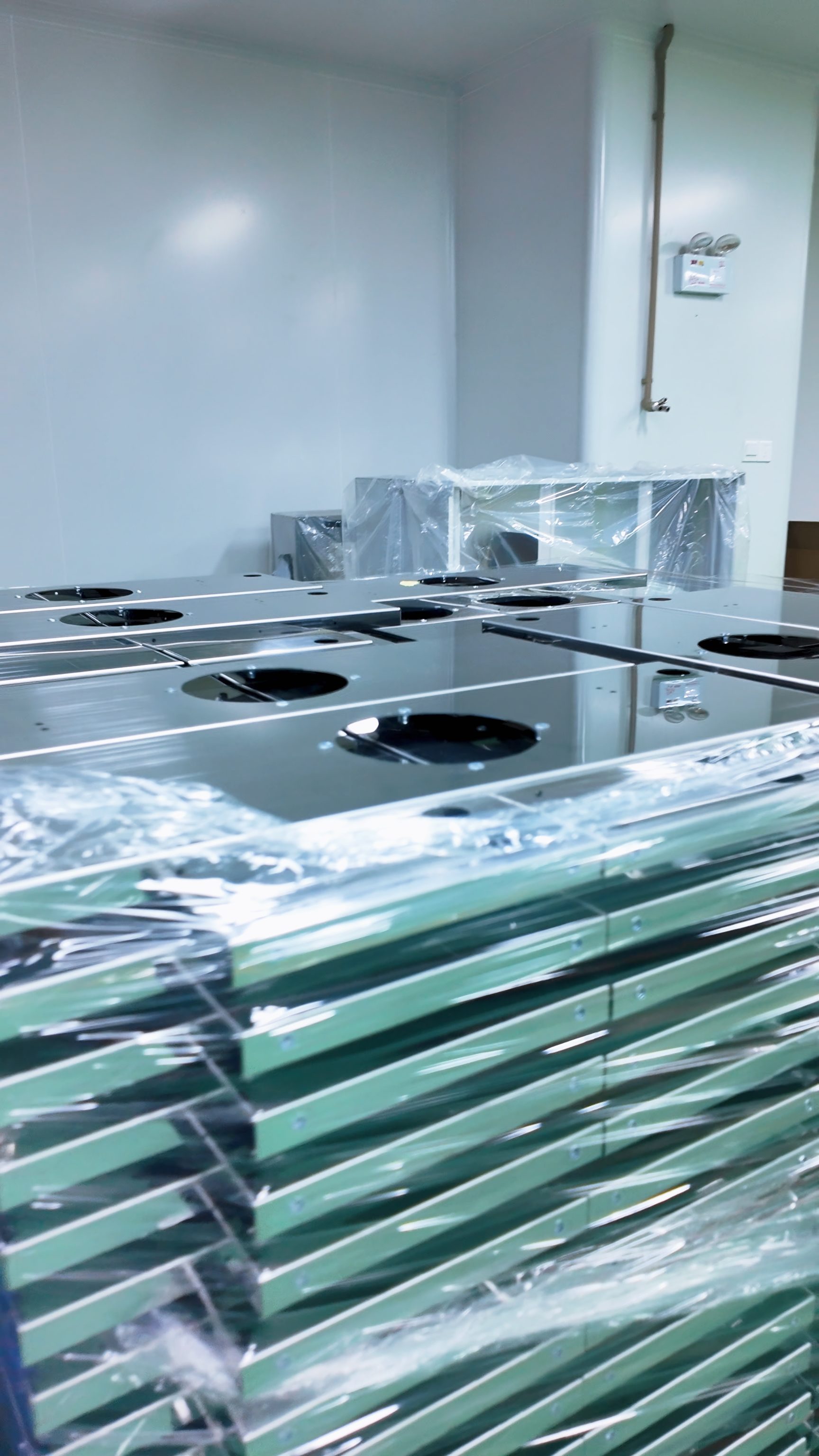
Some production lines tolerate a little drift. A few degrees warmer, a shift in humidity—most operators shrug and adjust on the fly. But for processes that depend on nanometer-scale alignment or moisture-sensitive chemistry, even a half-degree swing isn't a nuisance; it's a defect generator. Climate precision here means treating temperature, humidity, and airflow as active variables that get monitored, modeled, and corrected before they can touch the product.
The real challenge isn't hitting a setpoint once. It's holding that setpoint while doors open, equipment cycles, and outdoor weather fights against the building envelope. In these environments, control loops run fast—sampling multiple times per second, comparing against tightly banded alarm thresholds, and adjusting dampers or chilled water valves in real time. The goal is to make the room's atmosphere feel static, even when everything around it is moving.
That kind of steadiness changes how teams work. Instead of reacting to drift after it shows up in test data, they rely on environmental logs that look almost boring—flat lines, no excursions, nothing to explain. For processes that hate surprises, the best climate report is one that reads like nothing happened, because nothing did.
The Right Surfaces Make Cleaning Almost Automatic
Not all surfaces fight back when you try to wipe them down. Quartz counters, tempered glass, and high-gloss porcelain share a quiet secret: their non-porous, tightly bonded finishes leave almost no place for grime to grip. A splash of coffee, a smear of tomato sauce, or a dusting of flour simply sits on top, waiting for a single pass with a damp cloth. The material itself does half the work before you even pick up a sponge.
The real trick lies in how these surfaces handle moisture and residue. Smooth, sealed materials often carry a subtle hydrophobic quality, so liquids bead up instead of spreading into stubborn stains. Some even include embedded antimicrobial layers that slow down odor-causing bacteria, which means fewer aggressive scrubs with harsh chemicals. Instead of reaching for a heavy-duty degreaser, you often end up using nothing more than warm water and a microfiber towel.
Over time, choosing the right surfaces changes your whole cleaning rhythm. You stop dreading the post-cooking wipe-down or the weekly bathroom deep clean. What used to involve scraping, soaking, and elbow grease becomes a thirty-second task you barely notice. That shift matters because it frees up mental energy and removes the nagging feeling that your home is always one spilled glass away from a crisis.
Real-Time Monitoring That Catches What Eyes Miss
Most monitoring setups only tell you what happened after the fact. They log a spike, flag a threshold breach, and leave someone to piece together the story later. Real-time monitoring flips that on its head: it watches the stream as it happens, compares it against the expected pattern, and flags the subtle drift that would otherwise blend into noise. A slight latency increase on one endpoint, a memory curve that flattens too early, a retry count ticking up by two percent — these are not dramatic failures, but they are early fingerprints of a problem that standard dashboards will miss until it becomes an incident.
The real value is not just speed. It is the ability to catch what human eyes and static thresholds cannot. People can glance at four charts, maybe six. They cannot watch dozens of services and hundreds of signals all day without losing focus. Real-time monitoring works like a second set of eyes that never blinks, maintaining a continuous baseline and learning what normal looks like for your specific environment. When something deviates — even slightly — it puts that deviation in context, so the team can decide whether it is a harmless pattern shift or the first sign of something worth investigating.
This changes how teams work. Instead of reacting to pages at 2 a.m. after users have already noticed, engineers get a heads-up while the system is still compensating. They can trace the change before it compounds, often during business hours, before it reaches a customer-facing threshold. Real-time monitoring does not just shorten the detection window; it gives you a chance to prevent the failure altogether, turning what used to be crisis management into a routine check.
Gowning and Transfer Zones That Stop Dirt at the Threshold
The threshold between a controlled environment and the outside world is where most contamination slips through. A well-designed gowning zone does more than hold a bench and a rack of coveralls—it creates a physical and behavioral pause. Floors transition from high-tack mats to sealed resin or vinyl, air moves through filtered supply points to pressurize the space, and the layout forces a deliberate sequence: street shoes off, dedicated footwear on, then garment, hood, gloves. The step-over bench itself is not a convenience; it’s a barrier that separates the dirty side from the clean side. If you can walk straight through without changing your rhythm, the zone isn’t doing its job.
What stops dirt at the threshold is often less about the equipment and more about the order of operations. Garments should be donned from top to bottom—hood first, then coverall, then boots, then gloves—so that particles shed from the upper body don't settle on freshly covered legs. Transfer zones work best when they include a defined line of demarcation, sometimes marked by color or a physical curb, that signals exactly where the clean area begins. Many facilities also add a final mirror check and a sticky mat on the clean side to catch anything tracked past the gowning bench. The goal is simple: by the time a worker crosses into the production or lab space, the dirt from the outside has already been left behind, not carried forward.
Static Control That Keeps Sensitive Work Grounded
Static buildup is often invisible, yet a single discharge can ruin precision components or corrupt delicate measurements. Proper grounding turns a workstation into a predictable path for stray charges, bleeding them away before they find a costly route through your equipment. This principle matters most in cleanrooms, electronics benches, and anywhere microvolt signals need to stay clean.
A complete setup usually pairs conductive mats, wrist straps, and grounded tools with flooring or bench surfaces that share a common earth reference. But the real difference comes from maintenance: checking connections, cleaning surfaces without insulating residues, and verifying that every point truly drains to the same ground. When those habits become routine, static control stops being a cautionary note and starts working silently in the background.
FAQ
Filters remove sub-micron particles that can ruin sensitive processes, but the real difference comes from how well the airflow pattern is maintained. High-efficiency particulate air filters alone won't do much if the cleanroom suffers from turbulent zones or poor ceiling coverage, so the entire supply and return layout needs to work as a single system.
Cleanrooms typically maintain positive pressure relative to adjacent areas so that whenever a door opens, air flows outward instead of letting unfiltered air rush in. A well-designed cascade also staggers pressure levels between rooms of different cleanliness grades, which keeps particles from migrating through connecting corridors.
Fluctuations in temperature and humidity can affect static electricity, material expansion, and even microbial growth on surfaces. For processes like photolithography or powder handling, a drift of a couple degrees or a few percent relative humidity can change product yields, so tight control is a production requirement rather than a luxury.
Pass-through chambers use interlocked doors so both sides cannot be open at the same time, creating a physical buffer between the cleanroom and outside areas. This setup minimizes the volume of unfiltered air that can enter during material transfer and often includes local HEPA filtration or UV disinfection for added safety.
Yes. Poorly chosen fixtures can create heat loads that disturb laminar airflow, while recessed or sealed lighting prevents dust traps and simplifies cleaning. Good lighting also reduces operator fatigue and mistakes, especially in inspection tasks, so it indirectly supports both contamination control and production quality.
Smooth, non-porous surfaces like fiberglass-reinforced plastic or stainless steel resist particle shedding and can withstand repeated cleaning with harsh disinfectants. The fewer joints and seams, the fewer places for dust or microbes to hide, which keeps the cleanroom environment stable over years of operation.
Continuous particle counters, differential pressure sensors, and temperature/humidity loggers give early warning when conditions start to move outside the acceptable range. A good facility also sets alert thresholds below the actual limits so operators can adjust airflow or investigate sources before contamination reaches critical levels.
Gowning rooms serve as a controlled transition zone where personnel put on protective garments before entering the cleanroom. When designed with staged cleanliness levels and proper air supply, they reduce the amount of skin flakes, fibers, and street particles carried inside, which directly lowers the burden on the main cleanroom's filtration system.
Conclusion
A cleanroom only performs as well as its weakest interface, and the best facilities treat airflow as more than just filtered air movement. By shaping pressure differentials so that every doorway, pass-through, and seam pushes contamination outward rather than inward, the room becomes a protective envelope. Temperature and humidity stability matter just as much, especially for processes where a one-degree drift or a few percentage points of moisture can ruin a batch. Add surfaces chosen for low particle shedding and chemical compatibility, and routine wipe-downs stop being a chore and start being nearly foolproof.
What operators cannot see often causes the most damage, so live particle counts, pressure readouts, and environmental logs need to be visible without interrupting work. The smartest setups trigger alerts only when thresholds are actually crossed, avoiding alarm fatigue. Gowning areas and material transfer zones do the quiet work of keeping contamination at the door, with staged entry and HEPA-filtered pass-throughs that force dirt to stop before it ever reaches the critical zone. Finally, static control—through grounded flooring, ionizers, and dissipative surfaces—ensures that sensitive electronics and powders stay where they belong instead of clinging to gloves or drifting into places they should not be. Together, these features turn a controlled space into a truly reliable production environment.
Contact Us
Contact Person: Amy Yang
Email: [email protected]
Tel/WhatsApp: 008619330882686
Website: https://www.genopharmatech.com/